Oregon Light
Choosing between 12V and 120V pool lighting affects installation, equipment, maintenance, and electrical safety. What is the difference between 12V and 120V pool lighting? In practical terms, 12V fixtures operate through a compatible transformer, while 120V fixtures use line voltage. Neither option is automatically safer in every installation. Fixture listings, wiring methods, bonding, and protective devices matter.
The U.S. Department of Energy’s Energy Saver guidance reports that LEDs use at least 75% less energy and last up to 25 times longer than incandescent lighting. Those figures describe LEDs generally—not a guaranteed saving from choosing 12V over 120V. That distinction matters. A 12V LED and a 120V LED may have similar light output, while transformer losses and fixture design affect real-world performance. Think of a bright pool deck at dusk: the lamp’s beam, glare, and color often shape the experience more than its voltage.
This guide compares operating costs, transformer requirements, retrofit options, and maintenance considerations for 2026 projects. It also explains why pool-light installations must follow applicable electrical codes and manufacturer instructions; requirements can vary by location. Check the fixture label and consult a qualified pool electrician before deciding. Voltage alone is not a safety plan. DOE efficiency data offers useful context, but it does not settle every poolside choice—and that is worth keeping in mind.
How to Choose 12V vs 120V Pool Lighting in 2026?
Understanding 12V and 120V Pool Lighting Systems
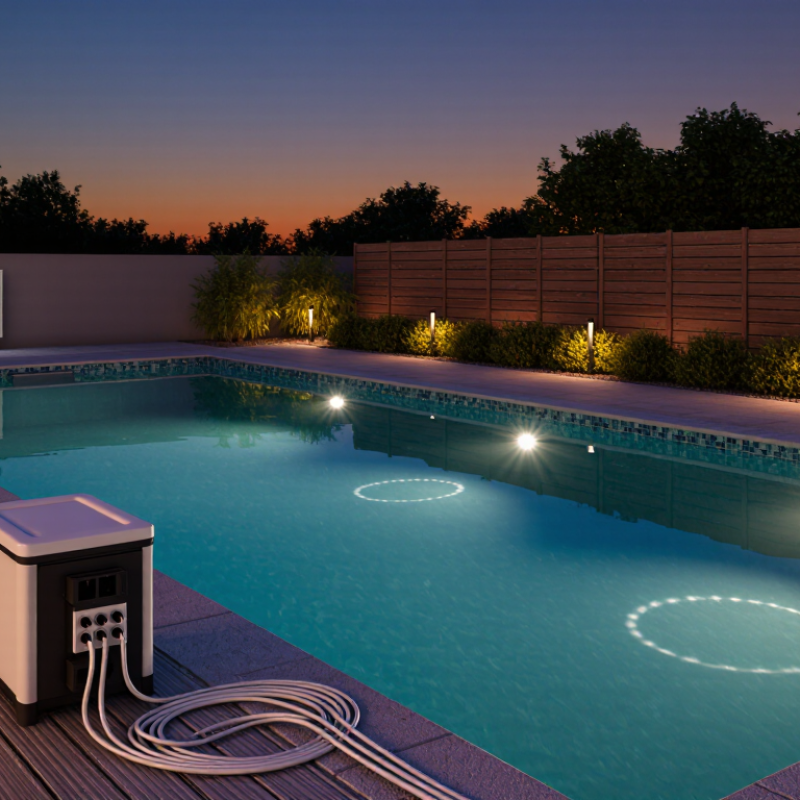
A 12V pool lighting system uses a transformer to reduce household voltage. It is common for residential pools and many renovation projects. Lower voltage can reduce shock risk, but it does not eliminate electrical hazards. Every connection still needs protection from water, corrosion, and physical damage. Small details matter. The transformer should remain dry, ventilated, accessible, and correctly sized for the total lighting load.
A 120V system connects directly to a suitable electrical circuit. It may support powerful fixtures, but higher voltage demands stricter installation controls. Grounding, bonding, waterproof connections, and ground-fault protection are essential. Local electrical rules may also require a qualified electrician. Voltage is not brightness. Fixture design, lens quality, cable length, and water clarity affect the visible result more than voltage alone.
The pool structure should guide the choice. A 12V system often suits retrofits because its transformer can simplify certain layouts. A planned 120V installation may work well when electrical access already exists. Check cable distance carefully. Long 12V runs can experience voltage drop, causing uneven or weak illumination. I once underestimated this detail. The light looked dull at the far end. It changed my checklist. Review transformer capacity, cable sizing, niche compatibility, and service access before installation.
Understanding 12V and 120V Pool Lighting Systems
This chart compares the current required by 12V and 120V lighting systems for equivalent power loads. The values are calculated using the electrical relationship current = power ÷ voltage. A 12V system requires substantially more current at the same wattage and normally uses a properly sized low-voltage transformer and conductors. A 120V system carries less current but requires installation and protection that comply with local electrical and pool-safety codes. Always confirm voltage, transformer sizing, grounding, bonding, and installation requirements with a qualified electrician.
How to Choose 12V vs 120V Pool Lighting in 2026?
Comparing Safety Standards and Electrical Code Requirements
Voltage affects installation requirements, but neither option is automatically safe. A 12V light uses a listed, pool-suitable transformer and can reduce shock risk if a fault occurs. It still needs correct wiring, grounding, bonding, and installation. A 120V fixture may be allowed where local rules permit it, but its circuit generally requires GFCI protection. In the United States, pool provisions in the adopted electrical code—often based on NEC Article 680—address equipment, wiring, bonding, and clearances. Local amendments matter. So does the fixture’s listing and intended use.
A practical choice depends on the pool, existing wiring, and the light’s installation method. For example, a wet-niche fixture and a low-voltage landscape light are not interchangeable. Have a qualified electrician confirm the transformer location, circuit protection, bonding connections, and required distances before work begins. A small mistake near water can be serious. I would not choose by voltage alone; product instructions and local inspection requirements can change the answer.
Tips: Check the code edition adopted by your local authority, and ask whether the exact fixture is approved for pool use. Keep the installation instructions for inspection. Never assume a 12V system needs no protection or that an existing circuit is suitable. That detail is easy to miss.
Choosing 12V or 120V pool lighting is not a brightness decision by itself. Compare lumen output, beam angle, and color quality on product specifications. Voltage isn’t brightness. A 12V fixture can illuminate steps well, while a poorly aimed 120V light can leave dark patches across the deep end. Picture the water at dusk, not just the fixture on a showroom wall.
Energy use depends mainly on wattage and operating hours, not voltage alone. A 20-watt light uses about 20 watt-hours in one hour, whether it runs at 12V or 120V. The U.S. Department of Energy’s Energy Saver guidance reports that LEDs use at least 75% less energy than incandescent lighting. That comparison concerns light technology, not voltage, so check the actual fixture type and rated watts.
Installation needs may tip the choice. A 12V system usually needs a compatible transformer, adding a component that must be correctly sized and placed. A 120V setup may avoid that transformer, but pool-area wiring still needs appropriate protection and professional installation. Check the label. Ask an electrician to confirm the circuit, cable run, and local pool-electrical requirements before buying. A long run to a far corner can change the practical choice, and it is easy to overlook until the trench is already open.
Choosing 12V or 120V pool lighting in 2026 depends less on brightness than system compatibility. A 12V setup usually needs a listed transformer, suitable cable, and compatible wet-location fixtures. Initial equipment costs can rise quickly. However, lower voltage can reduce electrical risk near water when installed correctly. A 120V circuit may cost less when an existing, code-compliant feed is available. It still requires GFCI protection and careful enclosure checks. Pool work is not a place for guesswork.
Compatibility often decides the real budget. Long 12V cable runs can suffer voltage drop, causing uneven brightness. The transformer must match the total fixture load. Oversized cable may be necessary. A 120V system can suit longer runs, but every fixture and junction box must carry the correct wet-location rating. A qualified electrician should verify bonding, grounding, conduit, and local inspection requirements. I have seen inexpensive lights become costly after an undersized transformer failed. That detail is easy to miss.
Over time, compare more than lamp prices. LED fixtures use less energy, yet sealed electronics may require full replacement after failure. Twelve-volt transformers add another maintenance point, especially in damp equipment areas. 120V systems have fewer conversion parts, but troubleshooting demands stricter safety controls. Keep spare gaskets, inspect cable entries, and test GFCI protection regularly. My early cost estimates were too optimistic when access was difficult. Measure the cable run, confirm the load, and allow for replacement labor.
| Decision Dimension | 12V Pool Lighting | 120V Pool Lighting |
|---|---|---|
| Typical application | Commonly selected for new residential installations and many replacement projects where low-voltage equipment is preferred. | Often considered for existing systems already wired for line voltage or for installations where a suitable low-voltage transformer is not practical. |
| Electrical supply | Requires a properly sized, listed 120V-to-12V pool-light transformer or an approved low-voltage power supply. | Connects to a 120V branch circuit designed for the pool equipment and protected by the required safety devices. |
| Electrical safety | Lower operating voltage can reduce shock severity risk, but the complete installation still requires code-compliant grounding, bonding, insulation, and ground-fault protection. | Has greater shock exposure potential because the fixture operates at mains voltage. Ground-fault protection, bonding, grounding, enclosure integrity, and code-compliant installation are critical. |
| Ground-fault protection | Usually installed with protection on the transformer primary or supply circuit, subject to local electrical requirements. | Normally requires a properly sized ground-fault circuit interrupter on the applicable branch circuit, subject to local electrical requirements. |
| Initial fixture cost | Typical residential LED fixture allowance: approximately US$150–US$500 per fixture, excluding installation. | Typical residential LED fixture allowance: approximately US$180–US$600 per fixture, excluding installation. |
| Additional equipment cost | May require a compatible transformer, generally about US$100–US$350 for a residential installation, depending on capacity and controls. | Usually does not require a step-down transformer, but may require circuit upgrades, protective devices, or a weather-resistant junction arrangement. |
| Installation cost | Often involves higher material and labor cost when a new transformer, long low-voltage runs, or upgraded conduit is needed. A typical two-fixture retrofit may total about US$700–US$2,000 before major structural work. | Can be economical when suitable 120V wiring already exists. A typical two-fixture retrofit may total about US$600–US$1,800, but new trenching, conduit, or panel work can increase the total substantially. |
| Energy consumption | Voltage alone does not determine efficiency. A 12V LED fixture using 45W consumes approximately 0.045 kWh per hour. | Voltage alone does not determine efficiency. A 120V LED fixture using 45W also consumes approximately 0.045 kWh per hour, excluding small supply losses. |
| Example annual energy use | At 45W, operated 5 hours per night for 180 nights: approximately 40.5 kWh per year, plus transformer losses. | At 45W, operated 5 hours per night for 180 nights: approximately 40.5 kWh per year, with generally low circuit and driver losses. |
| Voltage drop over distance | More sensitive to voltage drop because the operating voltage is low. Longer runs may require larger conductors, shorter circuits, or a remote transformer. | Less sensitive to voltage drop over the same distance when correctly designed, although conductor sizing and circuit length must still comply with electrical code. |
| Compatibility with existing wiring | Compatible only when the fixture, transformer output, cable type, connector, wattage, and control system are matched. A 12V fixture should not be connected directly to 120V. | Compatible only with fixtures and wiring rated for 120V pool applications. A 120V fixture should not be connected to a 12V transformer output. |
| Retrofitting difficulty | Usually straightforward when a compatible low-voltage conduit and transformer are already available. New transformer installation may require additional electrical work. | Usually straightforward when the existing niche, conduit, junction box, and branch circuit are rated and wired for 120V. Converting from 12V requires more than changing the lamp. |
| Color-changing and control compatibility | Many low-voltage LED systems support remote controls, timers, and synchronized color programs, but the transformer and controller must be compatible with the fixture. | Color-changing and dimming functions depend on the fixture driver and control protocol. Compatibility should be confirmed before connecting to existing switches or automation systems. |
| Maintenance frequency | Inspect the transformer, connections, conduit, bonding, and fixture seal at least annually; inspect sooner after water intrusion, flickering, or nuisance trips. | Inspect the branch circuit, protective devices, junctions, bonding, and fixture seal at least annually; electrical testing should be performed after any fault or water intrusion. |
| Common maintenance issues | Undersized transformers, overloaded outputs, voltage drop, corroded low-voltage connections, incompatible controllers, and water entering the fixture. | Ground-fault trips, deteriorated seals, corrosion, damaged conduit, loose bonding connections, driver failure, and water entering the fixture or junction box. |
| Expected LED service life | Quality LED modules are commonly rated around 25,000–50,000 operating hours, but heat, water intrusion, power quality, and seal condition affect actual life. | Quality LED modules are commonly rated around 25,000–50,000 operating hours, but heat, water intrusion, power quality, and seal condition affect actual life. |
| Replacement considerations | Match voltage, wattage, niche dimensions, connector type, transformer capacity, and control protocol. Replacing only the lamp may not be possible with an integrated LED fixture. | Match voltage, wattage, niche dimensions, branch-circuit rating, grounding and bonding arrangement, and control protocol. Do not assume a line-voltage fixture is interchangeable with a low-voltage model. |
| Best fit for a new installation | Often preferred Suitable when the project prioritizes low operating voltage, flexible fixture placement, and a dedicated transformer-based design. |
Situational Suitable when the electrical design, local code, and installation conditions specifically support line-voltage pool lighting. |
| Best fit for a retrofit | Usually preferable when a compatible low-voltage transformer and conduit are already installed or when the existing system is being modernized. | May be cost-effective when an existing 120V pool-light circuit is verified to be compliant and the replacement fixture matches the system. |
| Long-term cost outlook | Potentially higher upfront cost because of the transformer, but the fixture voltage itself does not guarantee lower energy use. Long-term value depends on power rating, runtime, reliability, and maintenance. | Potentially lower upfront cost when compatible wiring already exists. Energy cost is determined mainly by fixture wattage and operating hours, not by 120V versus 12V alone. |
| Recommended decision rule | Choose 12V when the electrical design supports a properly sized transformer, voltage-drop calculations, compliant bonding, and compatible controls. | Choose 120V only when the existing or planned circuit is specifically designed, protected, bonded, grounded, and approved for pool-lighting use. |
Planning note: Cost ranges are general 2026 U.S. residential planning estimates in USD and vary by pool structure, access, local labor rates, wiring distance, permitting, and code requirements. Electrical work near a pool should be designed, inspected, and installed by a qualified professional in accordance with applicable local regulations.
Choosing the right voltage for your pool in 2026 depends on safety, layout, maintenance, and local electrical requirements. For most residential pools, 12V lighting offers a more cautious approach near water. It typically uses a transformer and low-voltage circuits. That extra equipment adds cost and requires careful installation. Still, the added protection may be worth it.
A 120V system can deliver strong, consistent illumination across larger pools and longer cable runs. It may suit commercial settings or designs where powerful lighting is essential. However, installation demands stricter protection, correct grounding, and approved equipment for wet locations. A licensed electrician should inspect the circuit, bonding, and residual-current protection before use. Small mistakes can become serious.
I once underestimated cable distance on a pool renovation. The lights worked, but brightness dropped noticeably at the far end. That experience changed my planning process. Measure the run, calculate voltage loss, and leave access for future servicing. Do not choose voltage by brightness alone. Ask whether children use the pool, how often the area is maintained, and whether the transformer can stay dry and ventilated. Local rules can differ, even between nearby regions. A 12V choice is not automatically safer when seals, connectors, or installation practices are poor. Inspect those details closely.
No. A listed, pool-suitable transformer can reduce shock risk during a fault. Correct wiring, grounding, bonding, and installation still matter.
It may be permitted where local rules allow it. The circuit generally needs GFCI protection, and the fixture must be approved for pool use.
In the United States, local rules often follow pool provisions based on NEC Article 680. Code editions and local amendments vary.
No. Their installation methods and intended uses differ. Check the fixture listing and instructions before choosing one.
Ask them to verify circuit protection, transformer location, bonding, grounding, conduit, clearances, and inspection requirements. Small errors near water matter.
It usually needs a suitable transformer, compatible cable, and pool-rated fixtures. Long cable runs may also require thicker cable to limit voltage drop.
Voltage drop can make fixtures unevenly bright. The transformer must match the combined load, and the cable size must suit the run.
Inspect cable entries and gaskets, and test GFCI protection regularly. Transformers add another item to check, especially in damp equipment areas.
Not necessarily. They use less energy, but sealed electronics may require full fixture replacement after failure. Access and labor can change the estimate.
Measure the cable run, confirm the total load, and check existing wiring. My early estimates were too optimistic when access was difficult.
Choosing between 12V and 120V pool lighting in 2026 requires careful consideration of safety, performance, installation, and long-term value. What is the difference between 12V and 120V pool lighting? A 12V system uses lower voltage, making it a popular choice for wet environments where enhanced electrical safety is important. It may require a transformer and properly planned wiring, while 120V lighting connects more directly to a standard electrical supply and can support powerful illumination over larger areas. However, installation must follow applicable electrical codes and include appropriate protective devices.
Brightness, energy consumption, pool size, and existing electrical infrastructure should all influence the decision. Although 120V systems may offer simpler wiring in some installations, 12V options can provide efficient operation and flexible placement when designed correctly. Initial equipment, installation, transformer, replacement, and maintenance costs should be compared together. Ultimately, the best voltage depends on the pool’s layout, lighting goals, available power, local requirements, and the importance of long-term safety and reliability.